Paradise Lost Exhibition
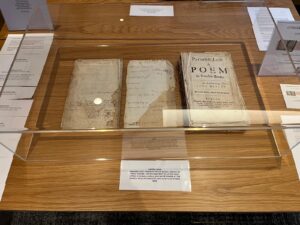 On 29 October the Library put on an exhibition to support the History Society lecture ‘Paradise Lost and Found’. Several items were on display including the Inn’s own 1688 edition, formerly owned by Royal Master of Revels, Charles Killigrew (1655-1725). The copy is particularly intriguing as it is annotated with the names of a number of contemporary members of the Inn. We know little about the copy or why the names are there, but it has been suggested that it was a working copy used to plan a dramatization of the work, perhaps even one staged at the Inn?
The Library staff’s favourite table featured copies of Eikon Basilike (1649), a text commonly attributed to Charles I that helped solidify his reputation as a martyr, Eikonoklastes (1650), a parliamentarian response from Milton written in defence of Charles’ execution, and a royal proclamation of 1660 calling for the suppression of Milton’s works. A tale that could certainly rival today’s biggest celebrity beefs.
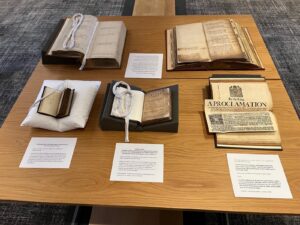 Also on display was Fitzherbert’s Abridgment (15th century), an ‘abridgment’ (or more correctly, index) of statutes arranged alphabetically by subject. Each new alphabetical section begins with a beautifully illuminated capital letter. The manuscript has recently undergone conservation, made possible by generous donations, allowing crucial cleaning and repair to take place. The Library’s website has more information about our ongoing sponsorship scheme.
The exhibition was a wonderful opportunity to peruse some of the lesser seen treasures the Library holds and learn more about the history of our collections.
An Outing for History Day
Umut Kav, Assistant Archivist, writes
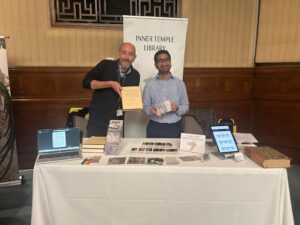 On 4 November the Inner Temple Library and Archive team helped celebrate History Day by having a stall at the University of London Senate House. The event was extensive, occupying two halls and a corridor of the building; we were one of many organisations represented, which included libraries, publishers, museums and historical societies. The Inner Temple Library and Archive’s stall was the only one representing an Inn of Court or a legal library more generally.
The theme for this year was LGTBQ+ history, with many of the other stalls going all out with pride flags draped over tables and material from their collections. We came prepared with a digital exhibition and timeline of the legal history of the LGBTQ+ community; although ours was not as bright and colourful as some of the other stalls we made up for this with key items from our collections, including copies of the Calendar of the Inner Temple Records, 1508-1608, and Catalogue of Manuscripts in the Library of the Inner Temple, as well as tablets displaying pages from our online catalogues.
As for freebies, visitors were able to collect a variety of postcards representing collections across the library and archives, including the Pegasus from the 1608 patent from King James I to the Inner and Middle Temple granting land to be used as an Inn of Court, a colourful image of the Court of King’s Bench from a 15th-century manuscript, and images of the Library and Hall after the devastating bombing of May 1940. We also gave out free bookmarks, representing members of the Inn who were the first in their fields, including prime ministers of newly independent countries and holders of important legal offices.
The day was a success: we had a wide variety of interactions (the postcards proving especially popular, although many of the other stallholders were impressed by the theme of our bookmarks). We had many opportunities to introduce ourselves and explain what our collections represented, this being very new to many people. We also received a wide range of other interactions: PhD students with a specific research project; people looking for a quiet place to study; even parents looking for an internship for their son. We were also able to reach out to the other stall holders and formed links with the Guildhall Library, who also have legal records, and received a lot of interest from the Society of Genealogists and Jisc. We had an incredible successful day, and by the end of it had already received 5 new enquiries. We will very much consider returning next year.
Tales of Cricket and the Law
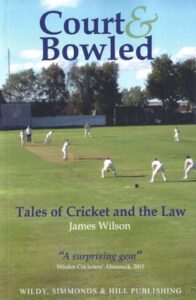 Simon Hindley, Senior Library Assistant, writes
As I write this, the first match of the 2025/26 Ashes series has just started. The Australian fast bowlers Pat Cummins and Josh Hazlewood were both ruled out of the match by injury, but in an entertaining day’s play Mitchell Starc took 7 wickets as England were bowled out for 172. England responded well, with Ben Stokes taking 5 wickets as Australia were reduced to 123 for 9 at close of play. It was the largest number of wickets to fall on the opening day of an Ashes Test since 1909.
Those readers who are interested in the above may also be interested in cases where the law and cricket have intersected. We recommend Court & Bowled: Tales of Cricket and the Law by James Wilson, kindly presented to the Library by its publisher, Wildy, Simmonds and Hill. Described by Wisden Cricketers’ Almanack as “a surprising gem”, the book includes chapters dealing with such subjects as defamation, “crimes on the field”, match fixing, Kerry Packer’s World Series Cricket, ball-tampering, and cricket clubs’ relations with their neighbours. The book can be found in the Legal Miscellany collection in Room A, conveniently close to two comfortable sofas.
By the time you read this the Perth and Brisbane test matches will have been decided, and England will be 2-0 up/down* in the series, and looking set/unlikely* to regain the Ashes.
*Please delete as appropriate.
Tours for Clerks
Please be reminded that if you have any new clerks in your chambers, or any clerks who would like a refresher on finding materials in the Library, we offer short tours of the Library where we look at how to find textbooks, law reports and journals, and we also advise on how to decipher legal citations.
Please contact library@innertemple.org.uk to book a session.
Mooting Society Library Legal Research Session
James Rowles, Senior Library Assistant, writes
In November I presented the legal research session for the Mooting Society. This is another opportunity for the Library to remind students of the substantial resources available to them as members of the Inn and how best to utilise the materials.
The session aims to be a practical look at how to research a point of law; in this session we used the example of “loss of control.”
We investigated how to find secondary sources both online and within the Library’s hard copy collections, which would explain this point of law and lead us towards the relevant legislation and case law.
Feedback was positive, one attendee saying, “we really appreciate your support”, and another, “very thorough and the step-by-step approach; worked well”.
Grand Day
Every year the Inn holds Grand Day, a celebration of the outgoing Treasurer’s term in office. As part of the day’s events the Library hosts an exhibition displaying some of the Inn’s treasures.
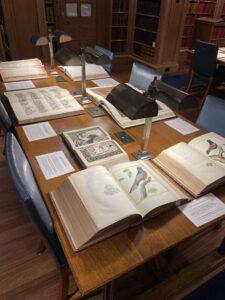 Items from the Archive were displayed in Room C, while books, letters and manuscripts from the Library’s collection took over Rooms D and E; coasters, Wi-Fi notices and kick-stools were all stashed away, transforming the Library into the perfect exhibition space. From the oldest surviving Bench Table Orders (1669) to Edward VI’s ‘Devise for the Succession’ (1553) written in his own hand, it was difficult not to be impressed by the items on display!
Our first ever multimedia exhibition could be found in Room E, themed around ‘Music Hidden in the Library Collection’. A highlight was ‘Melissomelos, or the Bee’s Madrigal’, a four-part vocal work inspired by and developed from the sound of the ‘piping’ of a queen bee. Visitors could hear the piece played through a speaker nearby while perusing the exhibits. From the archive there was a set of Bench Table Orders from 1682-1685 on display, detailing a conflict between the Middle Temple and the Inner Temple over which one of two commissioned organs was more suitable for use in the Temple Church.
It was a great evening, with a record number of visitors exploring and enjoying the treasures of the Inn.
Black History Month

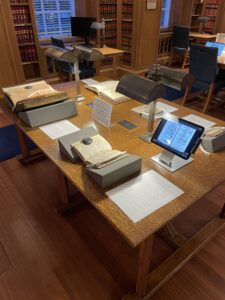
For Black History Month this year we had a selection of biographies and autobiographies on display:
- Do Right and Fear No One by Leslie Thomas KC
- Lovely One by US Supreme Court Justice Ketanji Brown Jackson
- Memoirs of a Caribbean Lawyer by Lewis Stephenson Hunte KC
- In Black and White by Alexandra Wilson
- Returned Exile: a Biography of George James Christian by Margaret D. Rouse-Jones
- Iris de Freitas Brazao by Joanne Collins-Gonsalves PhD FRHistS
- Colour Bar: the Triumph of Seretse Khama and His Nation by Susan Williams
- From Kingston to Kenya: the Making of a Pan-Africanist Lawyer by Dudley J. Thompson
- Taslim Olawale Elias: A Jurist of Distinction by I.O. Smith & C.A. Alade
- The Land is Ours: South Africa’s First Black Lawyers and the Birth of Constitutionalism by Tembeka Ngcukaitobi
- Defying Expectations by Dr Gifty Edila
- Barrister for the Defence by Rudy Narayan
In our lending collection we have some new titles including:
- Back Yourself: A Wellbeing Guide to Healing from Racial Trauma by Lildonia Lawrence
- The Louder I Will Sing: A Story of Racism, Riots and Redemption by Lee Lawrence
- Black History Every Day of the Year by David Olusoga (David O.), Yinka Olusoga and Kemi Olusoga
- We Were There: How Black Culture, Resistance and Community Shaped Modern Britain by Lanre Bakare
- The Shoulders We Stand On: How Black and Brown People Fought for Change in the United Kingdom by Preeti Dhillon
Lending Collection Book Highlight
How to Do Nothing by Jenny Odell
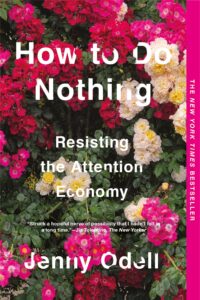 A New York Times Bestseller and Porchlight’s Personal Development & Human Behavior Book of the Year, How to Do Nothing: Resisting the Attention Economy by Jenny Odell might be just what is needed after the mad dash to wrap up work before the holiday season.
In a world where addictive technology is designed to buy and sell our attention, and our value is determined by our 24/7 data productivity, it can seem impossible to escape. But in this inspiring field guide to dropping out of the attention economy, artist and critic Jenny Odell shows us how we can still win back our lives.
Far from the simple anti-technology screed, or the back-to-nature meditation we read so often, How to do Nothing is an action plan for thinking outside capitalist narratives of efficiency and techno-determinism. Provocative, timely, and utterly persuasive, this book will change how you see your place in our world.
Rome Half Marathon: Keep the Librarians on the Move
 James Rowles, Senior Library Assistant, writes
To maintain the tradition of having a runner in the Library department, following the retirement of the famed runner and Deputy Librarian, Tracey, earlier this year, I participated in the Rome half marathon in late October.
The route is spectacular, and relatively flat, passing through many of Rome’s beautiful squares, such as Piazza Navona and Piazza di Spagna, and culminates with a finish right by the Colosseum. In my excitement at having completed this I quickly signed up for another Italian half marathon, in Naples, next February.
Who Writes the Laws
John F. Wilson, member of the Inner Temple, writes
The libraries of all the Inns of Court are wonderful repositories of legal textbooks, law reports – and statute law. The Inner Temple Library is particularly well stocked with volumes of statutes from former British territories, and some existing Overseas Territories; it shares this distinction with Lincoln’s Inn library. Some of them are in storage on the Inn’s estate but many are accessible on the open shelves. I sometimes wonder whether users of the library ask themselves who writes the laws that are contained in those volumes from Britain and from many parts of the Commonwealth.
Most lawyers know the names of some of judges who have made rulings in key cases, which have helped to create the law. There is the famous one in Donoghue v. Stevenson, the 1932 House of Lords case in which Lord Atkin pronounced his ‘neighbour principle’, the foundation of the law of negligence. Most readers will also know the names of the writers of legal textbooks whose names appear on the book. But no one knows the names of the people who wrote the thousands of statutes contained in hundreds of bound volumes on the shelves of every law library.
It perhaps never occurs to people, even lawyers, that there are specialists who actually write the text of the laws. It seems that in law schools, and in court, the writer of a statute is referred to (if at all) only as ‘the draftsman.’ (See Note below.) These days, a gender-neutral term would be used, but authorship is still anonymous. If there is to be criticism of a piece of drafting, perhaps anonymity is a useful protection. I am not saying that the writers of statute law should be named, in the same way that judges who deliver significant judgments are known, and textbook writers are known. But it would be nice to think that users of statutes realise there was a legal mind at work in the creation of the original Bill.
So, who are these people? They are usually law graduates; they might be barristers or solicitors or neither, but will have had some experience of law in practice. They are recruited through advertisement in the legal press, or by word of mouth, and will be people with a particular affinity for writing and for legal analysis. They will be prepared to spend hours in solitary contemplation of a set of ‘drafting instructions’ provided by a government agency (or occasionally by a law firm for a commercial entity). They will understand the need for a ‘plain English’ style of writing, rather than the archaic style of the past. They will know how to use good precedents without slavishly following them. They will be ready to defend their draft against criticism from a senior civil servant or a Minister or members of the legislature.
Statute law is, of course, not the product of a single mind, although some statutes are known to have been drafted in a single day by an experienced drafter. And some significant statutes carry the name of their main promoter in Parliament. But normally a statute is the product of a legislative process only part of which is the responsibility of the original drafter. The drafter might be required to draft Government amendments in response to decisions at Committee stage, and the end-product might be significantly different from the draft Bill that left the drafter’s desk or computer. (Non-government amendments are usually drafted by the members of the legislature or by ‘Parliamentary Agents’.) In some jurisdictions, such as Canada and Hong Kong, there will also be a bilingual version of a statute, which might have been drafted by someone else.
In the larger Commonwealth countries, law drafters do not receive formal training of an academic kind, but they learn ‘on the job’ by pairing with a senior member of the office. In England this is called the Office of Parliamentary Counsel, a term which has been used since the inception of the office under Lord Thring in 1869. The head of the office is ‘First Parliamentary Counsel’ and I was privileged to hold that title in Fiji for a few years. In other jurisdictions, the office might be called ‘Legislative Drafting Office’ or similar. In some small jurisdictions there is no separate law drafting office, and the drafting work is done in the Attorney General’s Chambers (which was my first experience of drafting in Tuvalu and in Montserrat). In Hong Kong, where I really learnt my trade, the large Law Drafting Division is now part of the Department of Justice.
For potential drafters from emerging Commonwealth countries there is a legislative drafting course run by the Institute of Advanced Legal Studies at the University of London. There are also several textbooks on legislative drafting, and on Plain English drafting. But perhaps the best training course (or CPD course) for law drafters of all ages is provided by the Commonwealth Association of Legislative Counsel. This is a professional body set up in Hong Kong in 1983, which is free to all law drafters in the Commonwealth. It holds conferences every two or three years and publishes a regular journal and a newsletter. The journal is called The Loophole, which is the logo of the Association and represents that which every law drafter tries to avoid creating …

So legislative drafters – or law drafters – must get used to not having their name appear on the legislation that they help to produce. The one exception is when a jurisdiction publishes a Revised Edition of the Laws, when the Law Revision Commissioner’s name will usually appear. (See for example the St Helena Revised Edition of 2017.) But otherwise, our satisfaction is knowing that we have helped achieve a new piece of legislation that will presumably benefit the community.
Note: In his judgment in Mirvahedy v. Henley and Another ([2003] UKHL 16; The Times, 24 March 2003) referring to section 2 of the Animals Act 1971, Lord Nicholls said, “Unfortunately, the language of the section is itself opaque. The draftsman’s zeal for brevity had led to obscurity. Section 2(2) has attracted much judicial obloquy.”