
A Note from the New Reader Services Librarian
By Sally Mclaren
 I started at the Inner Temple Library as a Library Assistant way back in the olden days (the early 2000s/pre-iPhone). It was my first law library gig, and if I’m being honest, before I started, I didn’t even know what an Inn of Court was (and there weren’t even any iPhones on which to look it up).
As it turns out, in addition to the Inns being awfully important in upholding the rule of law, they are also quite nice places to work. The libraries have a quasi-academic feel but are suitably practitioner-focused, so you are immediately exposed to all manner of complex legal research queries. Plus, the law can be pretty fascinating. Who knew?
After studying for my Master’s in Library Studies part-time, I got promoted to Assistant Librarian. I have been fortunate enough to be able to develop the role quite a bit, be involved in some really interesting work, and have the opportunity to launch some passion projects. 20ish years on (well, that escalated quickly …), I have a new role at the Inner Temple Library, a step up to a brand new post – Reader Services Librarian.
And, without wanting to be too much of a nerd, it is a role I am really, really excited about. There is a lot I would like to work on: developing our training programme, improving our data collection and analysis so we can better listen to our users, and making our library services and spaces more accessible and inclusive, to name but a few.
TL;DR: Old-timey Librarian still excited to be developing stuff.
Baccarat Case
By Jessie, Graduate Trainee
Picture this: a cold night in East Yorkshire, a smoky room in a Victorian manor house, an illegal game of cards… gone wrong. This is how I like to imagine it, at least, looking back on the Royal Baccarat Scandal, which first crossed into the legal world 135 years ago this February. The story goes that, while visiting Doncaster Racecourse, the Prince of Wales (future King Edward VII) and a close circle of friends were guests at Tranby Croft, home of the industrialist Arthur Wilson. During a game of late-night Baccarat the host’s son, Stanley Wilson, spotted another member of the party, Sir William Gordon-Cumming, dubiously altering his bet. Other members of the party were soon informed of Stanley’s suspicions and, after close observation, reported spotting the same behaviour. Eventually the prince was informed, and Gordon-Cumming was forced to sign a document “tantamount to an admission of guilt”; this secured his companions’ silence on condition that he never played cards again. As with all good secrets, however, word of his supposed cheating eventually got out. In February 1891, when they refused to rescind their accusations, Gordon-Cumming issued a writ for slander against five members of the party, claiming £5,000 against each.
The trial that ensued saw the prince make an involuntary appearance in court, the first heir to the throne to do so since 1411 (and the last senior royal to take the stand until Prince Harry’s court appearance, 130 years later). The prince’s performance in the witness box was viewed as unfavourable, while Gordon-Cumming’s barrister gave a closing speech later described as “probably the most conspicuous example of the moral courage and independence of the Bar that has occurred in modern times”. The trial seemed to fall clearly in the defendant’s favour, and public opinion was against the Prince of Wales and his ‘set’, but the jury delivered a verdict against Gordon-Cumming after just 13 minutes deliberation. Some sources say prolonged hissing could be heard from the gallery.
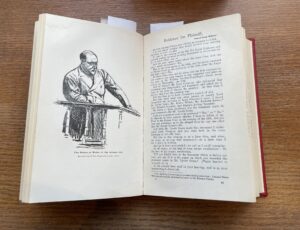 There’s obviously plenty of scope for speculation here. Did the host’s position as an industrialist add fuel to the flames? Was the jury’s verdict influenced by a desire not to decide against the Prince of Wales? Wikipedia will even tell you that the the prince and Gordon-Cumming were on bad terms before the fateful game, when the former’s mistress had been found in the latter’s arms! It’s a story so dramatic it even inspired a play, and if you’d like to read more of the juicy details (or just reminisce about a time when our royal scandals were slightly more tame) you can find the story of the trial on the shelves at the Enquiry Point, in the series Notable British Trials. There are even pictures!
Wellbeing Spotlight
Tucked away in the corner next to the photocopier room, our lending collection is easy to miss but full of gems. All titles can be loaned by any library user, you do not need to check them out and there is no return date, but we recommend a loan period of 3 weeks. We recently added a selection of new titles:

The Psychological Safety Playbook
Karolin Helbig & Minette Normal
The essential guide for leaders who are committed to fostering psychological safety in their teams.
Happier Hour
Cassie Holmes
Happier Hour demonstrates how to immediately improve our lives by changing how we perceive and invest our time.
The Creative Act
Rick Rubin
A beautiful and generous course of study that illuminates the path of the artist as a road we can all follow.
The Let Them Theory
Mel Robbins
The Let Them Theory puts the power to create a life you love back in your hands – and this book will show you exactly how to do it.
Bibliotherapy
Bijal Shah
Full of practical advice and insights into how bibliotherapy really works, Bijal offers an A to Z reading list of books for every mood and need.
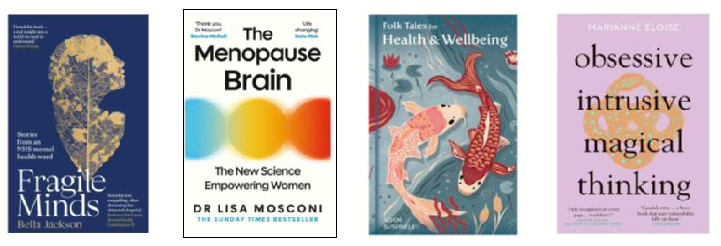
Fragile Minds
Bella Jackson
Fragile Minds documents Bella Jackson’s time as a trainee mental health nurse, and the devastation and hope she encountered in winding corridors and behind locked doors.
The Menopause Brain
Dr Lisa Mosconi
Mosconi reveals how menopause doesn’t just impact the ovaries – it’s a hormonal show in which the brain takes centre stage.
Folk Tales for Health and Wellbeing
Adam Bushnell
This collection of folk tales from around the world will serve as a gentle guide, leading you to a more mindful, peaceful and present way of life.
Obsessive Intrusive Magical Thinking
Marianne Eloise
Obsessive Intrusive Magical Thinking is the culmination of a life spent obsessing, offering a glimpse into Marianne’s brain, but also into the lives of others like her.
Bishopsgate Institute Visit
By Jessie, Graduate Trainee Librarian
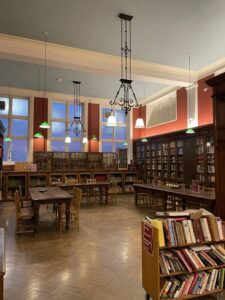 In January I was lucky enough to be invited by some fellow library trainees on a tour of the Bishopsgate Institute. I ventured out on a drizzly afternoon with no idea what to expect, having not been previously familiar with the Institute, but the visit was more than worth braving the rain. After a stroll through their beautiful Victorian reading room (brought very much into the 21st century by some impressive artwork focusing on marginalised groups – a recurring theme in the collection), we were led through to a research room, and on to the archive. The archivist, Stef, led us on a fantastic tour through the vast and varied collections the Institute holds, soundtracked by an orchestra that was rehearsing next door. Favourite items included Bernie Grant’s mobile phone and Walkman (accompanied by some very cool mixtapes), a stuffed Donald Trump in a cage collected from a protester, and the bed frame of a renowned London lesbian, collected by the archive for reasons I shall not repeat here. A highlight of the tour for me, as a somewhat sentimental soul, was the archive of the great diary project. From the collection of 20,000 diaries of ordinary people Stef showed us a small selection including the diary of a secretary in the 1950s who, behind 365 ordinary entries, had recorded in the back page details of her… let’s say… conquests that year (including eye colour, height, career, and more!), and a pocketbook from the 1970s which, after each entry, had a note addressed to the writer’s partner who had passed away the previous year.
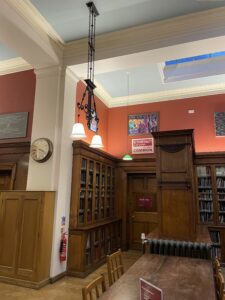
The tour was both a fabulous opportunity to see and enjoy the weird and wonderful items the Bishopsgate collects, and a fascinating insight into the ways archives and libraries can record and represent people, groups, and items that are often forgotten, if not ignored, by history. Learning about how such a diverse collection is created and managed was fascinating. I was particularly delighted by some of the unique challenges Stef reported facing – I’m not sure anyone here at the Inner Temple Library has had to ask themselves how best to preserve latex. It was a great afternoon out, and I would encourage anyone interested to book for one of the Institute’s archive tours open to the public. If you’re as lucky as I was, you may even get to sit in a chair once used by John Stuart Mill!
Radzinowicz Criminology Library Visit
By Karolina, Library Assistant
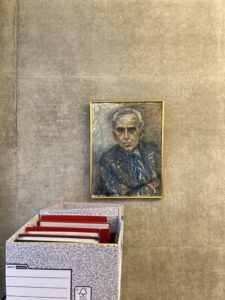 Last December, Sally and I traveled to Cambridge to visit the Radzinowicz Criminology Library. Founded in 1960 by Sir Leon Radzinowicz, the first Director and founder of the Institute of Criminology, it is the UK’s most comprehensive criminology library, containing approximately 80,000 items.
When the library was founded, its entire collection was made up of items donated by academics and professors to whom Radzinowicz appealed personally. Nowadays the collection grows via new acquisitions made by the Senior Library Assistant and books requested by students, and the library aims to strike a good balance between teaching and research material.
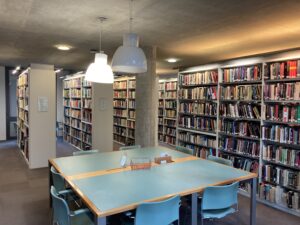 The collection is housed on two floors, and the spacious, airy building is popular with students. In addition to its core collection of books covering topics of criminology, sociology, policing, social policy and welfare, human rights, and forensic psychology and psychiatry, the library also has bound copies of every MPhil (Distinction) Criminology dissertation submitted to the university. Its crowning jewel, however, is the vast and irreplaceable pamphlets and government publications collection, which includes items that the Senior Library Assistant is confident cannot be accessed anywhere else. They also hold a collection of prison journals and newspapers, such as Inside Time.
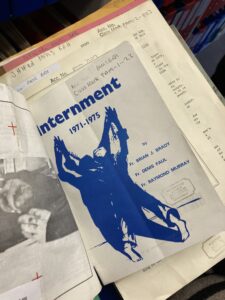
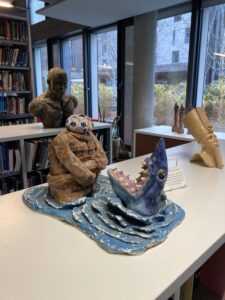
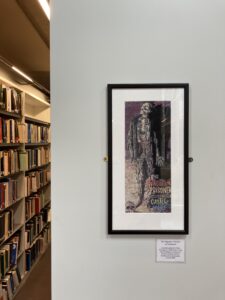
The most unique thing about the Radzinowicz Library is its large collection of artworks made by prisoners and other detainees. Most of this collection has been purchased through the Koestler Trust, UK’s oldest prison arts charity, which aims to inspire prisoners to engage with the arts and build and nurture communities that support rehabilitation. The library has used library fines to purchase the art works, with half of the money going to the artist and half to the Koestler Trust and Victim Support. For lack of wall space to showcase the entirety of the collection, the art works on display are shown in rotation, with the rest stored in the basement archives. From mosaics to ceramic sharks and cross-stitched skeletons, the artworks imbue the library with a sort of electric energy which is seldom found in spaces designed for quiet study.
The Royal Courts of Justice Visit
By Tina, Library Administrator
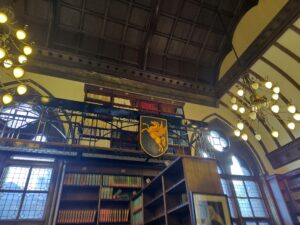 Four of our Library team visited The Royal Courts of Justice (RCJ), just over the road from us, in February. After going through security we were greeted by the Librarian Stephanie Curran and taken up a few flights of stairs and long dark corridors to the Library, where we were given a history of the RCJ and Library by her (recently retired) colleague Andrew.
The High Court of Justice is one of the senior courts of England & Wales. It has three main divisions (The King’s Bench Division, The Chancery Division and The Family Division) and hears appeals from the High Court and the Crown Court.
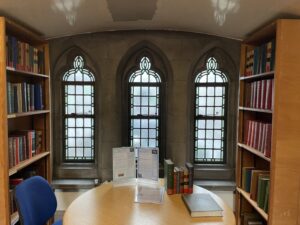 The RCJ building was designed by George Edmund Street RA in the Victorian gothic style, and covers 6 acres. Paid for by funds from intestate estates, work started in 1873 and finished in 1881, the year Street died. Queen Victoria officially opened it in 1882.
The Library was created as a reference and lending library for barristers and clerks. It is now used by judges only and split into two main rooms: the former Bar Library and the former Probate Library, with books also in other small rooms and along corridors. The old Bar Library where we started has a high wooden ceiling with the four Inns’ shields around the walls and a roundel on one end with all four Inns’ shields and the words “Inns of Court Bar Library”. It was known as the fifth Inn. The gallery is made of iron and beautifully decorated. The chandeliers are also impressive though not the originals but copies thereof.
 The main printed collection ends at around 2007, and any later editions are available in electronic format only. The holdings consist of an extensive reference collection, textbooks, human rights cases and reports, and Halsbury’s Laws and Statutes. The library uses an adapted version of the Moys Classification Scheme.
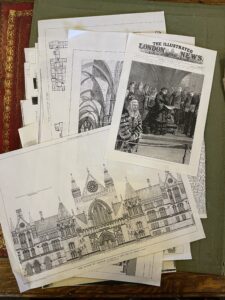
On display when we visited were: (i) an exhibition of non-law books (the earliest dated 1567); (ii) plans and drawings of the RCJ building by some of the architects who competed for the contract build it; and (iii) a timeline of LGBTQ+ history, starting in Roman times.
We were then taken to the Times Library, which houses bound volumes of The Times from 1939 to 1977, printed books (many of them old editions of law treatises) and dictionaries. Our guide pointed out that much of the older material in the Library was presented by judges.
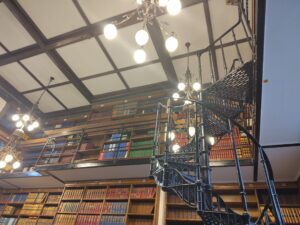 The Probate Library was next. Here we were introduced to the Library team and offered tea/coffee and biscuits. The suspended gallery in this room is accessed by a spiral staircase, described as “wonky, but safe”, and featuring decorative ironwork similar to what we had seen in the Bar Library.
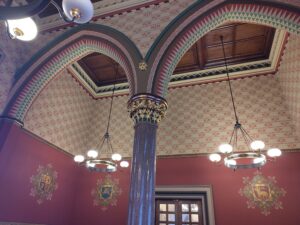 The tour ended with a look at the permanent Legal Dress Exhibition, featuring the robes worn by various categories of judge at different dates. We were shown an intriguing bust of Master Woolf made by the sculptor David Mach RA from metal coat hangers, then walked through the Painted Room (with more shields of the four Inns of Court) and the Bear Garden (so called because Queen Victoria said the noise coming from it sounded like a bear pit) and finally enjoyed views of the Great Hall, resembling a cathedral with its high ceilings, decorated pillars and stained glass windows.
Our thanks are due to Stephanie and her team for showing us around and introducing themselves and their work. It was a very enjoyable and informative visit.
Senate House Visit
By Jessie, Graduate Trainee
In February I once again ventured out of the Inn through rain and wind to visit a new library. This time I was a guest at Senate House Library. If you’re like me, and have (now had, of course) never visited before, you may not be familiar with the University of London’s imposing administrative headquarters. My first impressions were formed when, ahead of my visit, a colleague informed me that the building had been used for the exterior shots of the Ministry of Truth in the 1984 film adaptation of Orwell’s Nineteen Eighty-Four. They were solidified when the first thing my tour guide divulged was that the building had, in fact, served as inspiration for Orwell, whose wife worked for the Censorship Department of the Ministry of Information based in the building; talk about a claim to fame! The building’s imposing exterior, however, is nothing compared to the beautiful library housed within.
The second thing my tour guide shared was a throwaway comment about how it’s not too hard to find your way around. I, however, would have been lost without him. The library was a wonderful space, filled with everything from big open halls lined with books and filled with sofas, to cramped stacks, with each new bay of shelves leading to another nook or cranny housing a cosy study desk, and all of it was a maze (in the best way possible). As I’m hoping to commence studying at UCL in September, it was very exciting to imagine myself scribbling away in some of the comfier corners.
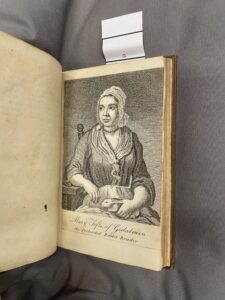
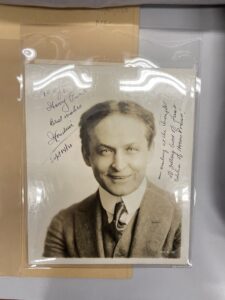
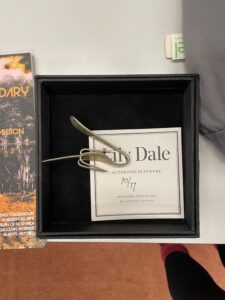
After exploring the sprawling space, we sat down with the Librarian, Catríona Cannon, who shared stories and lessons from her career (having started out as a graduate trainee), her insights were interesting, funny, and full of great advice. To conclude the visit, we were treated to a whistlestop tour of one of their special collections, the Harry Price Library of Magical Literature. Items ranged from pamphlets debunking Mary Toft, the woman who claimed to have given birth to rabbit, to a signed photo of Harry Houdini (I wasn’t aware that he looked quite so ghostly) and letters from Arthur Conan Doyle. I was particularly impressed with the misshapen fork that had been bent using telekinesis, or so the accompanying note claimed. I knew I was among the experts when the member of staff introducing us to the collection referred to Dan Aykroyd not as the Ghostbuster, but as the fourth generation spiritualist… Who knew?
Rarebytes
By Michael, Assistant Librarian
Following the belated return of the contents of the manuscript store on completion of Project Pegasus, an extensive shelf-listing and cataloguing exercise based on that part of the collection served as a reminder that a good number of volumes in the manuscript collection are in fact printed books, but are classed as manuscripts (or simply shelved alongside the manuscripts) on account of the handwritten annotations or additions they contain. Of particular interest are of course those items with an Inner Temple connection. Among these is Sketches of the Intrinsic Strength, Military and Naval Force of France and Russia (1803), classed as Misc. MS. 142. An anonymous work, this was in fact written by Francis Maseres (1731-1824). Maseres was a barrister of the Inner Temple (admission 1750; call 1758; Treasurer, 1781-82, by which time he had been appointed a cursitor baron of the Exchequer) and a fellow of the Royal Society. He served briefly as Attorney General for Quebec in the period shortly after it became a British province. Maseres was a generous benefactor of his Inn’s library: apart from the manuscripts he presented, around fifty published works have been found to bear his signature, and there are almost certainly a good many more yet to be identified.
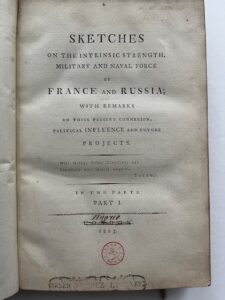
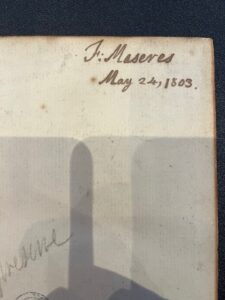
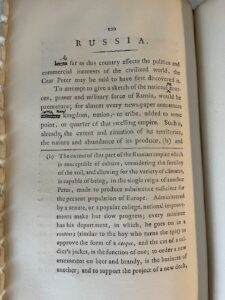
Sketches of France and Russia does not feature in any library catalogue included in Library Hub Discover, which covers a large proportion of the UK’s academic and research libraries, so it is presumably of considerable scarcity value. J. Conway Davies, compiler of the catalogue of manuscripts, wonders whether this copy may represent the author’s proof copy, and that the work was never in fact published. There are frequent corrections in Maseres’ very clear hand, both to the punctuation and to the text. The textual changes occasionally lead one to suspect that the typesetters were more familiar with French than with English. This would probably make sense if, as suggested by the corrected title-page, the work was printed in the Hague rather than in London.
It is ironic that Maseres’ arguably most timely work (he was writing on the verge of the Napoleonic Wars, after all) should have enjoyed no circulation to speak of.
Voices Through the Centuries: The Inner Temple Oral History Project Returns
By Celia, Archivist
The archive of the Inner Temple has a collection of documents that date back to 1505, providing an unbroken history of the Inn through its accounts, committee minutes and membership records. Many famous people are included among the alumni of the Inn, yet our knowledge of their time here is often limited to their admission and call records, or their contributions to the administration of the Inn. The opportunity to record people’s experiences at the Inn provides us with a full picture of many of the personalities who either work or study here, and brings to life the voices and experiences of people whose lives might otherwise be relegated to a few pieces of paper
This May, the Inner Temple is relaunching its Oral History Project, beginning with a training day for volunteer interviewers on 6 May. The aim is to record the memories, experiences, and personalities that don’t always make it into the official records.
The Oral History Project helps fill in the gaps, creating a richer, more human picture of life at the Inn at a time when the legal profession is changing fast. The interviews gathered so far span more than 50 years of memory, offering not just professional history, but social history too.
The first phase of the project began in 2011, and was led by the late Master Daire Brehan, who interviewed a total of sixteen Benchers, barristers, residents, and student members.
Some spoke about life before the Second World War, when much of the Inn was destroyed in the Blitz. Master Monier-Williams warmly recalled the “lovely old grubby, sooty buildings” that stood before the Luftwaffe’s bombing, and reflected on his own time here as pupil, barrister, and Bencher.
Cynthia Langdon-Davies, one of the Inn’s longest-residing tenants, remembered the 1960s when children were a common sight around 6.00pm as barristers packed up and headed home. This paints a picture of an Inn that felt like a small village. She also recalls a former Treasurer leaving his daughter in a pram in Fountain Court with a note attached: “Please do not feed Fiona.”
A second phase of interviews followed in 2013, this time conducted by volunteer members of the Inn, drawing on a wide cross-section of our community.
Now, the project is beginning again. Volunteer interviewers will receive a full day of training from Sarah Lowry, a freelance oral historian working with the British Library, which will equip them with the skills and confidence needed to record conversations for the archive.
If you are interested in taking part, or if you know someone whose experiences of the Inn deserve to be recorded please contact Celia Pilkington: cpilkington@innertemple.org.uk
Five hundred years from now, today’s committee minutes will, we hope, still exist. But thanks to this project, so too will the voices, humour, and humanity behind them. You can listen here to some of the interviews.
