
Summer Opening
From the 3 August to 4 September the Library will open at 9am and close at 5.30pm. Late night opening begins again on Monday 7 September. Please note that the Library will be closed from Monday 17 August to Monday 31 August inclusive.
AI in the Library
By Sally, Reader Services Librarian
Generations of law students will be familiar with a tiny pocket-sized volume entitled Learning the Law by Glanville Williams. His guidance on research remains uncompromising: “All your direct quotations must be verbatim; all your citations must follow accepted forms; all your statutes must be checked to make sure that they have not been amended or repealed; and if there be any doubt, the cases you cite as authorities must be checked to make sure they have not been reversed, overruled or questioned.” This advice is fundamental. The rapid development of AI and its use as a research tool does not change this; if anything, it makes it all the more salient. Artificial intelligence introduces many efficiencies, but also distinct risks. For many barristers, the question is no longer whether to use AI, but how to do so without compromising professional standards. General purpose AI tools often produce fluent and persuasive summaries, but fluency should not be mistaken for reliability. These systems are not built on authoritative legal datasets; they may omit key authorities, oversimplify complex issues, or generate incorrect citations. Platforms such as Lexis+® with Protégé™ and Westlaw Advantage are designed around established legal databases. Their outputs are linked to identifiable and authoritative sources (including cases, legislation, and commentary) allowing researchers to verify and interrogate material more efficiently. With general AI tools, every output must be verified. With legal-specific AI tools, that burden remains but begins with a more reliable foundation. Used carefully, AI can complement established research methods, although the essential work of reading, analysing and applying the law remains a human responsibility.
Lexis+® with Protégé™
LexisNexis Protégé™ is now available for use in the Library. Lexis+® with Protégé™ ‘is the personalised generative and agentic AI assistant within Lexis+ that powers conversational search, insightful summarisation, intelligent legal drafting, and document upload and analysis capabilities.’
Online training sessions with a LexisNexis trainer will be available on:
Clerks Tours
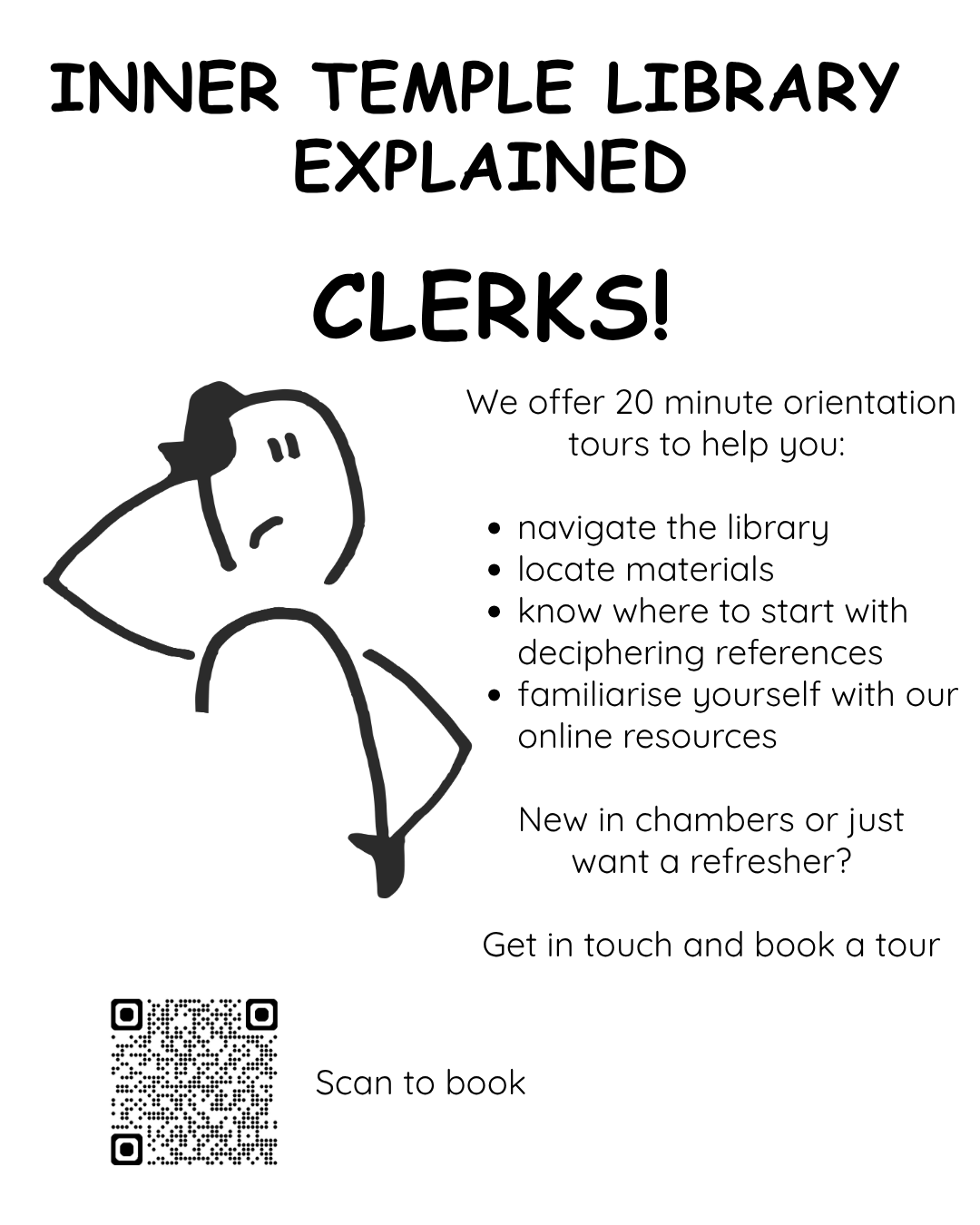 The Library offers 20 minute orientation tours to help you navigate the library, know where to start with deciphering references and familiarise yourself with our online resources. New in Chambers or just want a refresher? Get in touch and book a tour now.
Library Special Collections Exhibition
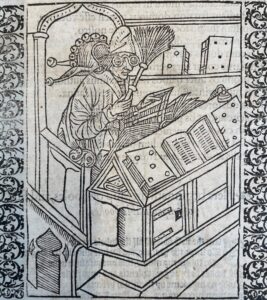
This is an invitation to find out more about the Inner Temple Library special collections. Ranging from the 12th to the 21st century, and covering a disparate range of subjects, our special collections contain thousands of items that even the most inquisitive Library user is unlikely to have encountered on the open shelves. Book your ticket to view a hand-picked selection of these items up close and in person on Tuesday 21 July, guided by members of the Library team.
Book for tours starting at 5pm, 6pm and 7pm.
New Acquisitions
See the list of New Law Titles and Editions recently received by the Library between March and May 2026.
Wellbeing Spotlight
 This month the Library is celebrating Pride Month with a display from our lending collection. One book on display is The Stonewall Reader, a powerful collection of “first accounts, diaries, periodic literature, and articles from LGBTQ magazines and newspapers chronicling the years leading up to and the years following the Stonewall uprising”.
Filled with the voices of incredible activists and forgotten figures alike, this powerful account of “the most significant event in the history of the gay liberation movement and the catalyst for the modern fight for LGBTQ rights” is as potent as ever in our increasingly volatile political climate. A both fascinating and sobering read.
Items from our lending collection can be borrowed by members and staff alike. We recommend a three-week loan period, but this is flexible. Unlike when loaning other titles from the library, books from this collection do not need to be checked out at the enquiry point.
IALS Training
By Jessie, Graduate Trainee
As a part of my traineeship I am regularly given leave to attend training covering all aspects of librarianship, and during March I was kindly invited to the Institute of Advanced Legal Studies to learn about different sources of legal information. The training took the form of four sessions covering sources of EU law, US law, foreign law, and public international law. The sessions, each taught by a different member of IALS Library staff, were attended by graduate trainees from the four Inns of Court, the Law Society, and IALS Library itself.
The programme was a great opportunity to learn about jurisdictions outside of our regular experience here at the Inner Temple; I’ve gained a very helpful bank of resources and deepened my understanding of how different legal systems function. It was also a welcome chance to meet and learn alongside my peers; it is always interesting to hear about and draw parallels between the different law libraries in London as someone fairly new on the scene.
A big thank you to IALS and their library staff for having me!
HistoryHit: Queen Jane: The Extraordinary Life of Lady Jane Grey
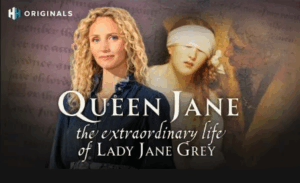
Filming took place in the Library for part of the documentary Queen Jane: The Extraordinary Life of Lady Jane Grey, first shown in April on the online streaming service HistoryHit.com. This new two-part film has the presenter, Dr Suzannah Lipscomb, go in search of the truth about Lady Jane Grey, who was Queen of England for nine days in July 1553. Our copy of Edward VI’s “Devise for the Succession” and Librarian feature in the programme.
HistoryHit.com is a subscription-only online streaming service that offers exclusive access to hundreds of historical documentaries and podcasts.
House of Lords Visit
By Jessie, Graduate Trainee
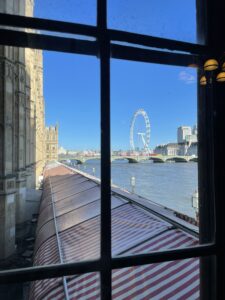
In March I was kindly invited to visit and learn more about the House of Lords Library. It was a fascinating visit but for security reasons I shall keep my recap brief and stick to the best bits (there was a limit on photo opportunities…). After an airport-style security check, I received a fantastic tour of the library, and a whizz around the House more generally.
Highlights of the morning were: pausing in the central lobby to watch the Speaker’s procession towards the Commons; spotting Ed Davey across a room; and getting to step inside the House of Lords chamber. (The seats are not as comfy as they look.)
My favourite quirks included: the busts in each room of the library, the post office branch in the lobby (who knew!), and the fact that the carpet changes colour as you move between the House of Lords and the House of Commons. There is a lovely multi-coloured carpet for the one corridor shared by the two.
I was particularly interested in the extent to which the library is directed by members. My tour guide explained that peers can request practically any title if they can justify its relevance to parliamentary proceedings, and that as a result they had a rather extensive biography collection. This policy was most visible when browsing the newspapers and magazines on offer. There were more titles than I could possibly remember, although I do recall ‘country life’ being a rather prevalent theme among them.
Despite the grandeur of the building, the beauty of the library, and the famous faces to be glimpsed, I was most impressed by the tunnel that takes staff and members directly to Westminster tube station. What can I say? I’m passionate about public transport links.
Visit to St Edmund Hall, Oxford
By Jessie, Graduate Trainee
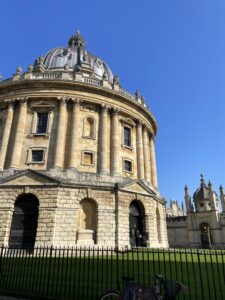
On the first sunny day of the year I was lucky enough to be released from the Temple for the day to visit St Edmund Hall, an Oxford college known affectionately as Teddy Hall. As I had never visited Oxford before, I made sure to arrive with plenty of time to stray from the path between the station and the college to take in some of the sights. Catching the Radcliffe Camera in the morning sun was lovely, and it was great to get a peak at the Bodleian Library before all the crowds appeared.
Upon arriving at the college I was confused to be pointed in the direction of a church, only to discover that this was the current home of Teddy Hall’s library. After introductions to the small team (they operate with only 3 members of library staff!), I was given a tour of the space by their Graduate Trainee. We discussed some of the pitfalls of operating a library within a 12th-century church, such as managing noise when every ‘Shhh’ produces echoes, or the challenge of remembering which collection is in the North Chapel, and which is in the Vestry but, ultimately, it was the thought of the heating bill that really rattled me…
All, however, seemed completely worth it when I imagined how fabulous it must be to study under the watchful eye of a 15th-century stained glass window. (You can get a peak of this on their website.) Other unique perks included the tower, at the top of which sat a very quirky space once used for seminars (and now housing a rarely touched run of the Law Journal, tut tut!), and a crypt below the library that now hosts concerts (and no ghosts, I was assured). As cool as it was, I am rather glad we don’t have to clear towers and crypts at closing time.
Afterwards I had a chat with staff over coffee about the unique aspects of running a college library. I was interested to hear about their relationship with the Bodleian, and touched to learn about the library’s involvement with the university’s regional outreach programme, where each college is tied to a region of the UK and runs outreach events with local state schools that have low university progression rates, as I had been on the receiving end of this programme some 7 years ago!
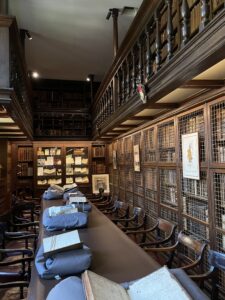
After a delicious lunch in the college dining hall (whether it beat Inner Temple Hall lunch is still up for debate…) the team kindly showed me around the rest of the college. The archive, as I’m learning is true for most archives, was wonderfully random, and the chapel was a beautiful space. The highlight for me, however, was the old library. Situated above the chapel, and about the size of our Room F, the old library was like a time capsule. The space is now used only occasionally for exhibitions and special events, but from what I hear it was once a pioneer among hall libraries, being the first to have wall-mounted shelves and a gallery. I was treated to a tour of some fabulous items held in the old library, including a bound collection of the magazine instalments (pre-dating the first book publication) of Oliver Twist, a treatise on the properties of holy water, and, every old book fan’s favourite item, an historic atlas! It was a privilege to be allowed to peruse such treasures in such a venerable space.
During the tour I was told how students could request specific books for purchase, and if the book satisfied certain requirements (much like our own Patron-Driven Acquisition Scheme) a member of staff would take a trip to Blackwell’s bookshop, often on the same day, to pick it up. When my day at the college concluded, I couldn’t resist a trip there myself; readers will be unsurprised to hear that no librarian can resist a good bookshop. After that I whizzed through the Ashmolean Museum but found I could no longer resist the sunshine, so settled into a pub where, readers may be surprised to hear, I ordered two pints and got change out of a tenner! Not a bad way at all to spend a Thursday evening.
On a more serious note, it was a very interesting and insightful day, and I’d like to extend real gratitude to the staff at Teddy Hall library for their time, hospitality and kindness. Come and visit us soon!
Rarebytes: Book of Common Prayer
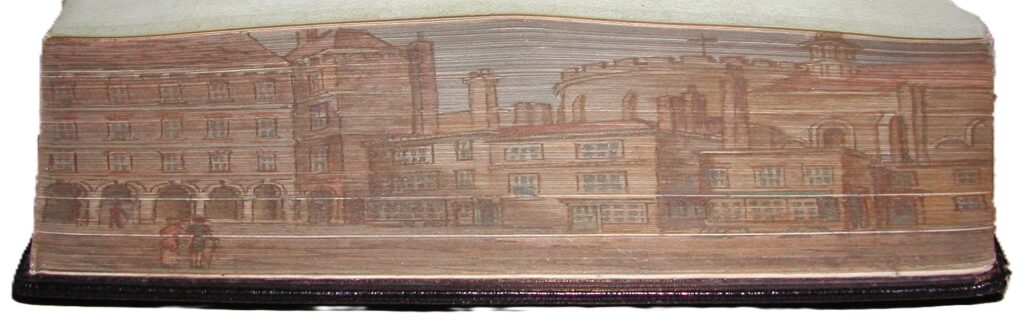
This small and unassuming copy of the Book of Common Prayer hides a (pleasant) secret. A hand-painted image of the Temple Church and Cloisters is concealed behind the gilt page edges. This is an example of a hidden or ‘disappearing’ fore-edge painting. Invisible when the book is closed, it only becomes apparent when the text block is slightly fanned or tilted.
Historically, early books were shelved ‘fore-edge out’. The current vogue for shelving books with the spine facing out slowly gathered pace in the 17th century. Page edges formerly offered a convenient place to add marks of ownership, indicate the library shelf mark, or (as with this example of Thomas Ashe’s 1614 Promptuary[1]) to identify the volume itself. Previously owned by John Glanville the Younger (1586-1661), parliamentarian and sometime Recorder of Plymouth, this copy’s fore-edge is clearly marked ‘Ashe 1st’.
The provenance information for the Book of Common Prayer is scant; it was presented to the Library by Master Godfray Le Quesne in 2005 and features a signature inscription on the flyleaf that reads ‘Elizabeth Bull, March 9 1854’. It is highly unlikely that the image was painted at the time of publication, but we have no information about who painted it, or when. John Carter notes in ABC for Book Collectors that “it is very difficult indeed to decide whether an individual fore-edge painting was executed in 1780 or 1930”. Fore-edge paintings remain quite sought after by book collectors, and it is hard not to wonder how many more ‘disappearing paintings’ remain unnoticed in library collections.
[1] The Promptuary was an early printed subject index to the Year Books and their contents.
Preserving Voices: Inside the Inner Temple’s Oral History Workshop
By Umut, Archives Assistant
The stories of an institution are not only found in its records and archives, but in the memories of the people who have lived and worked within its walls. With this in mind, the Inner Temple Archive has launched a new round of its Oral History Project — an initiative dedicated to capturing the experiences, reflections and personal stories of influential barristers and staff connected with the Inn.
The project continues the important work begun by the late Daire Brehan, barrister, broadcaster and storyteller, whose interviews with residents, students and staff created a valuable record of life at the Inner Temple. This latest phase marks the next chapter in a project that has continued to evolve since 2008.
 Following a successful recruitment campaign (both online and in print) twelve volunteer interviewers were selected to take part. On 6 May, the group gathered for a day-long workshop led by Sarah Lowry of the Oral History Society and the British Library Training Team, who introduced participants to the art and practice of oral history interviewing.
The group itself reflected the diversity of the Inner Temple community. Current students joined long-serving barristers and staff members, including one volunteer returning from the previous stage of the project in 2013. Each participant brought their own motivation: some were eager to develop new skills and expand their professional networks, while others were drawn by a passion for storytelling or curiosity about how oral history interviewing differs from courtroom advocacy or journalism.
Throughout the day, Sarah guided the group through the evolution of oral history as a discipline, sharing examples of interviews that demonstrated both effective and less successful techniques. Participants explored how to prepare meaningful questions, build rapport with interviewees and navigate the practical challenges of recording personal recollections. Practice interviews in pairs gave everyone the chance to put theory into action.
The workshop had proved not only informative, but genuinely enjoyable, filled with lively discussion, thoughtful reflection and enthusiasm for the project ahead. As the new team of interviewers begins recording the voices and memories of the Inner Temple community, the project will, we trust, preserve an invaluable living history for generations to come.
History Society Lecture
By Celia, Archivist
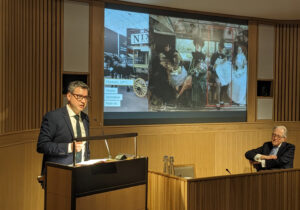
We were delighted to welcome Dr Valentin Jeutner to the Inner Temple for a fascinating lecture exploring the history and evolution of the legal concept of ‘the reasonable person’, a figure used in law to help assess how an individual might think, feel, or act in a particular situation.
Dr Jeutner traced the origins of the reasonable person back to the ancient world, drawing connections between the silent person of Ancient Egypt (geru maa), the earnest person of Ancient Greece (ho spoudaios), and the paterfamilias of Ancient Rome. He explained how the concept later emerged in common law during the period of British industrialisation, shaped in part by the ideas of the Scottish enlightenment, as a tool to support fairer and more accurate judgments in an increasingly complex society.
The lecture attracted an audience of more than a hundred, in person and online, and prompted thoughtful discussion throughout the evening. A reception followed the event.
Reconstructing the Petyt Printed Book Collection at Inner Temple Library
Written by Anika Wadood, our recent student intern, who reflects on her research project.
When I began my internship at the Inner Temple Library earlier this year, I expected to spend my time cataloguing books and learning about special collections. What I did not anticipate was becoming absorbed in uncovering the story behind a long-lost early modern library and the man who bequeathed it. Taking the first steps towards piecing together the remains of a three-century-old collection that may have been scattered, damaged, and potentially destroyed during World War Two has been a truly revelatory experience.
The project centres on the bequeathed printed book collection of William Petyt (1640-1707), a barrister, historian of Parliament, and Treasurer of the Inn (1701). Petyt was a prominent figure within the Inn’s rich early modern history, contributing his knowledge and service throughout his life and after his death. My work during this internship represents the first systematic attempt to identify what survives of the Petyt printed book collection from the 18th Century catalogues.
Who Was William Petyt?
William Petyt grew up in Skipton, Yorkshire, and later moved to London to study Law whilst working as a Clerk at Middle Temple. After graduating from Cambridge University, he was admitted to Inner Temple in 1664. As a member of the Inn, Petyt practised as a Barrister whilst writing influential works on the history and functions of Parliament and later served as Treasurer in 1701-02. Arguably this collection was an act of legacy-building and institutional loyalty.
The Petyt Bequest
On the 12 of July 1705, two years before his death, Petyt bequeathed his personal library of books and manuscripts to the Inn, describing the collection as the product of “years of pain and study”. He left £150, (equivalent to £31,743.17 today) to construct a suitable space to preserve his collection, a further £50 (equivalent to £10,578.06 today), to expand it, and he appointed six trustees, including his brother Sylvester, to ensure his books were preserved and safeguarded. These actions demonstrate a deep desire for his collection to be maintained and accessible for the future minds of the Inn for generations to come, and this portrays Petyt as a man who genuinely cared and wanted to give back to the Inner Temple society.
Unfortunately, Petyt’s hopes did not persist in the way he intended. The most dramatic rupture came during the Second World War, when the Inner Temple Library suffered devastating damage during the air raid of 10-11 May 1941. Almost the entire building was destroyed, and with it, we assume, a large portion of the printed books that formed part of Petyt’s bequest. What remains is a fragmented and incomplete collection where library catalogues now form the backbone of any attempt to understand what printed books Petyt donated, what was added after his death, and what has survived. This project has given me the responsibility to act as a Petyt trustee over three centuries after the bequest and begin the process of reconstructing a record of what survives.
The Project – The Books of William Petyt
My work began with the contemporary manuscript list of items bequeathed, a substantial volume written in early 18th century handwriting that required careful palaeographical work to decipher. It remains true today that there are many more surviving Petyt Manuscripts than books. This is probably because more manuscripts were bequeathed, combined with the fact the manuscripts were evacuated before the war, therefore more manuscripts survived.
The titles were long, often in Latin and French, and the organisation of the volume was not entirely straightforward. Antiquity titles were interwoven with history, dates were irregular, and some entries lacked authors. Despite these challenges, I was able to transcribe 162 printed titles from the first volume alone. The catalogue included a majority of historical works including accounts of medieval monarchs, succession histories, and Parliamentary journals, alongside a substantial number of legal texts, and a smaller group of antiquarian works. Even at this early stage, the catalogue reveals Petyt as someone who was deeply interested in constitutional history, monarchy, and the workings of Parliament.
Cross-referencing these titles with the current digital catalogue added another layer to the story. Some surviving books still bear Petyt’s ownership marks, while others do not, suggesting either a mixture of original items and books purchased with the £50 provided in his will, or simply some titles that may not have been signed. The digital catalogue also reflects how cataloguing practices have evolved over the centuries after being passed through the hands of different librarians, as many Petyt books are now classified as “folio non-law”, when they used to be classified by subject.
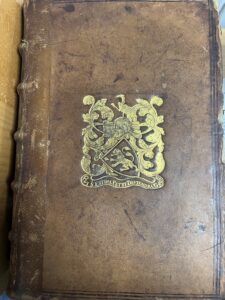
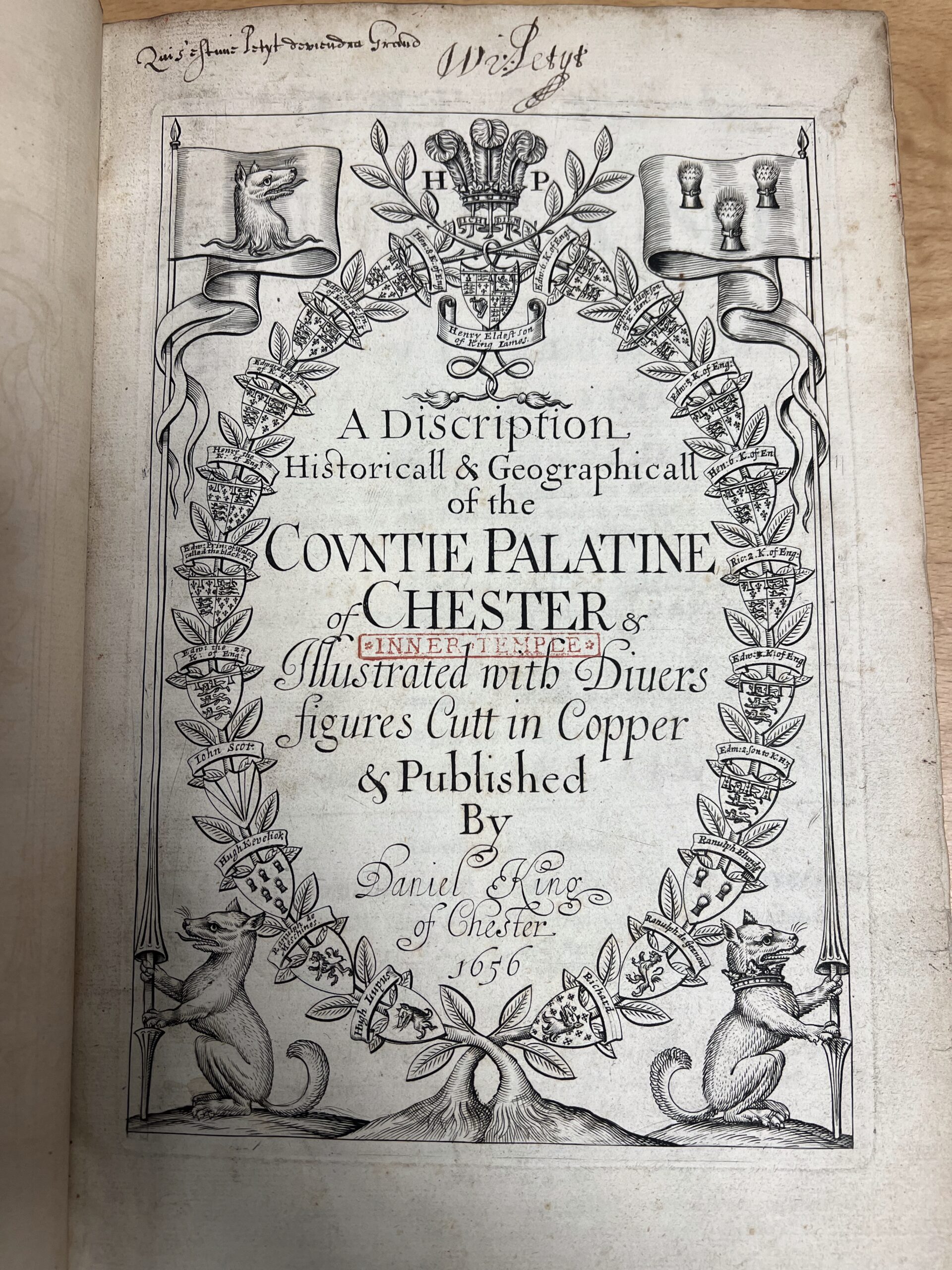
When I examined the physical copies of some extant collection items, I discovered certain markings left by William Petyt that solidified his ownership of these books. When examining Petyt’s signature that he signed over 300 years ago, I envisioned him writing it with a fresh feather quill dipped in an ink as dark as obsidian. Many books were embossed with distinct gold tooled armorial bearings, displaying the Petyt motto with a crane holding a pebble and a lion rampant. The motto ‘Qui s’estime petyt deviendra grand’ is also often written on the title page. These details hold significance because they turn the collection into physical proof of Petyt’s ownership and intellectual identity, reminding future readers that these books once belonged to him.
The printed collection’s history is complicated by certain factors. Later catalogues are much smaller, which led me to question how big the collection of printed books was compared to the vast collection of manuscripts. It was found that Sylvester took 2000 items from the collection to their “Yorkshire Home”, and this made me question whether these items were books because of how few there remained in the bequest. Because his motives remain unclear, I formulated multiple theories that could explain this striking action. The Petyt brothers may have had a private agreement, or Sylvester could have added his own materials to William’s collection during his lifetime and sought to reclaim them. Their “Yorkshire Home” could refer to multiple locations including the Petyt Skipton collection which was developed whilst they were alive. Would Sylvester have added more to a collection that was already extensive, going against William’s intentions of bequeathing his entire personal collection to the Inn? Regardless of the true answers, this action highlights how vulnerable early modern libraries were to the choices of individuals, whose private motives could reshape, fragment, or redirect entire collections.
And it was not only individuals who shaped the fate of the collection. Much of what survives today is only because of chance: catalogues that escaped the bombings, a volume that happened to be shelved elsewhere, a stamp or signature that confirms its provenance. Reconstruction is therefore far from straightforward. No single surviving volume can provide all the answers, and the second and third catalogues may reveal information that complicates or contradicts initial conclusions. This uncertainty reflects the reality of the project: slow, meticulous but rewarding, with each fragment offering a glimpse into the intellectual world of an early modern legal figure who helped shape the scholarly identity of Inner Temple.
As the project continues, the next steps will involve transcribing the remaining catalogues, examining surviving volumes for their condition, marginalia, and ownership marks, and comparing the Inn’s holdings with the Skipton collection to uncover patterns such as Petyt’s reading habits, the books he used most, and intellectual and political interests. The aim is to build a clearer picture of the original size and character of the printed book collection, to understand patterns of loss and survival, and to complete a long-term research tool for the library.
As Rachel Hammersley observed in her work on the Skipton collection, “documents and books are powerful tools and those who curate them, as the Petyts did, wield great power over what is remembered and what is consigned to oblivion”. My findings echo this: even the administrative traces of the Petyt collection opened multiple avenues for deeper research into memory, preservation, and the shaping of institutional knowledge. This project marks the beginning of bringing a lost library back into view.
